

What is Cap?
Cap is an Ethereum-based credit protocol that mints cUSD, a dollar-denominated stablecoin, and stcUSD, a staked version that earns yield. cUSD is backed by a basket of stablecoins including USDC, PYUSD, BlackRock’s BUIDL, and Franklin Templeton’s BENJI. Holders can unstake stcUSD to cUSD and redeem for USDC at any time, with no lock-up period.
What distinguishes Cap is its model of funded underwriting. Rather than generating yield through in-house strategies, Cap lends deposits to borrowers, typically institutional trading firms, each of which must be vouched for by an underwriter who posts their own capital as collateral. If a borrower performs, the underwriter earns a premium. If the borrower defaults, the underwriter’s collateral is slashed to make depositors whole. This is a departure from centralized yield products where decision-makers and recourse are opaque. With Cap, the guarantees are explicit and enforced in onchain code.
The Problem: Idle Crypto Assets in a Walled Garden
Traders on the Fomo app buy and sell tokens, but profits taken between trades typically sit idle inside the app, earning nothing. DeFi offers a way to put those assets to work, yet moving funds out of a consumer trading app and into a DeFi protocol has historically required bridging, gas tokens, and several manual steps across chains that a casual trader is likely not familiar with.
For Cap to grow, it needs to bring new users into its protocol, but blockchain UX stands in the way. Reaching stcUSD from a consumer app traditionally means withdrawing, bridging, acquiring gas, swapping, and staking across multiple interfaces. Even for someone experienced with digital assets, that process can sometimes take up to thirty minutes. For a new user, the entire path is full of friction, confusion, and places to fall off before a single stablecoin is deposited.
The Solution: Halliday
Halliday simplifies the multi-step journey into a single transfer. A user connects a wallet on Cap’s get started page, enters an amount, and is returned the Halliday deposit address. From there, they withdraw USDC from Fomo to that address and sit back. For Cap, this means the onboarding surface lives on its own site rather than in a third-party bridge or exchange, keeping the user inside Cap’s experience from the first tap.
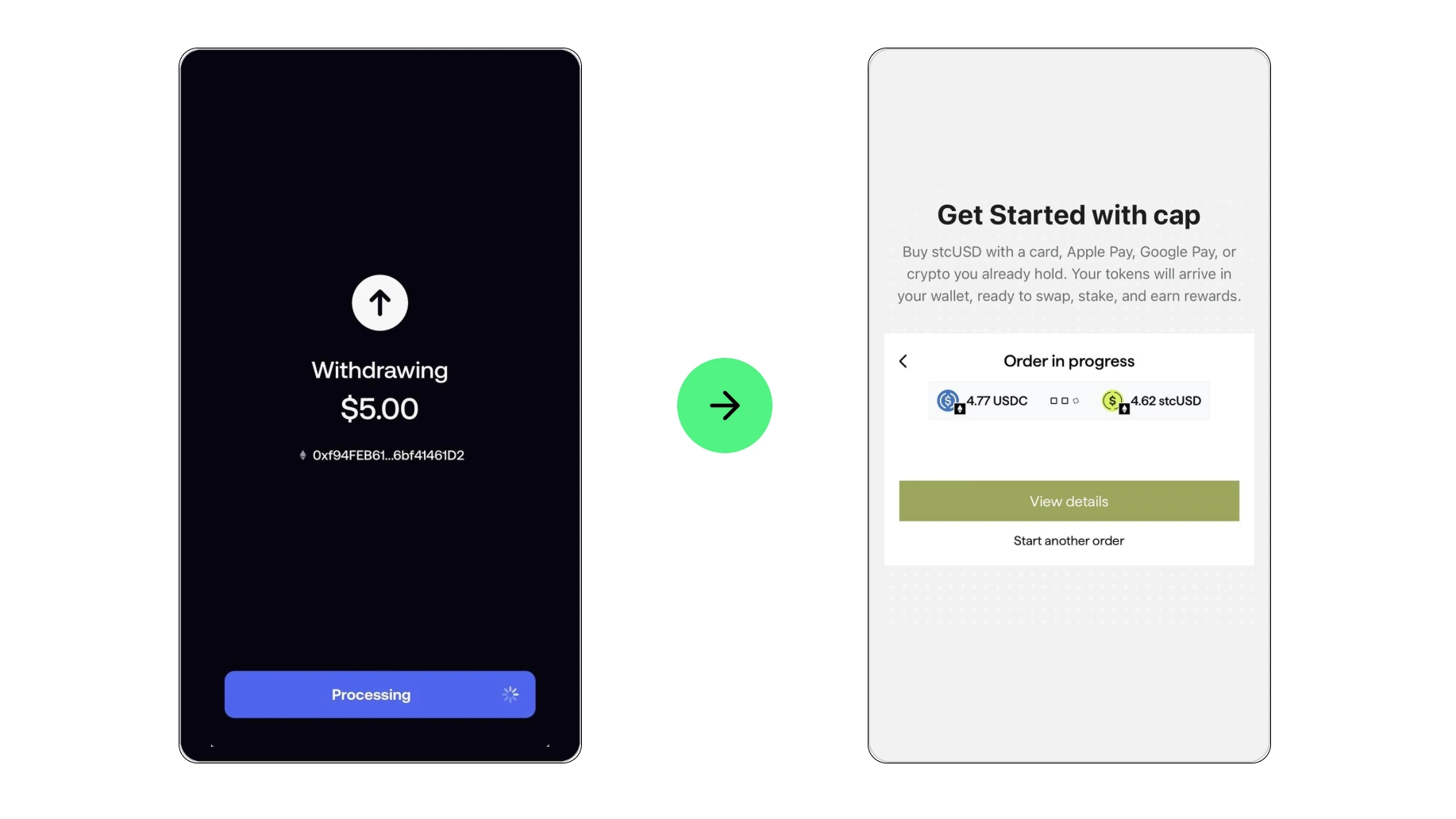
Once the USDC arrives in the deposit address, Halliday’s protocol swaps it into cUSD and stakes it into stcUSD in one automated flow. The user does not need to consider bridges, gas tokens, or optimal routing. This removes the technical steps that historically filtered out non-native users, which allows Cap to reach traders on consumer apps like Fomo who would otherwise not connect with a DeFi protocol.
The result is a deposit path that takes just a few minutes instead of thirty, with live status updates along the way. Users land directly in stcUSD, Cap’s yield-bearing token, held in a wallet the user controls. They can unstake and redeem for USDC whenever they are ready to move back to Fomo or cash out. For Cap, a shorter and more transparent path means fewer drop-offs, more deposits, and a broader base of users earning yield with the protocol.
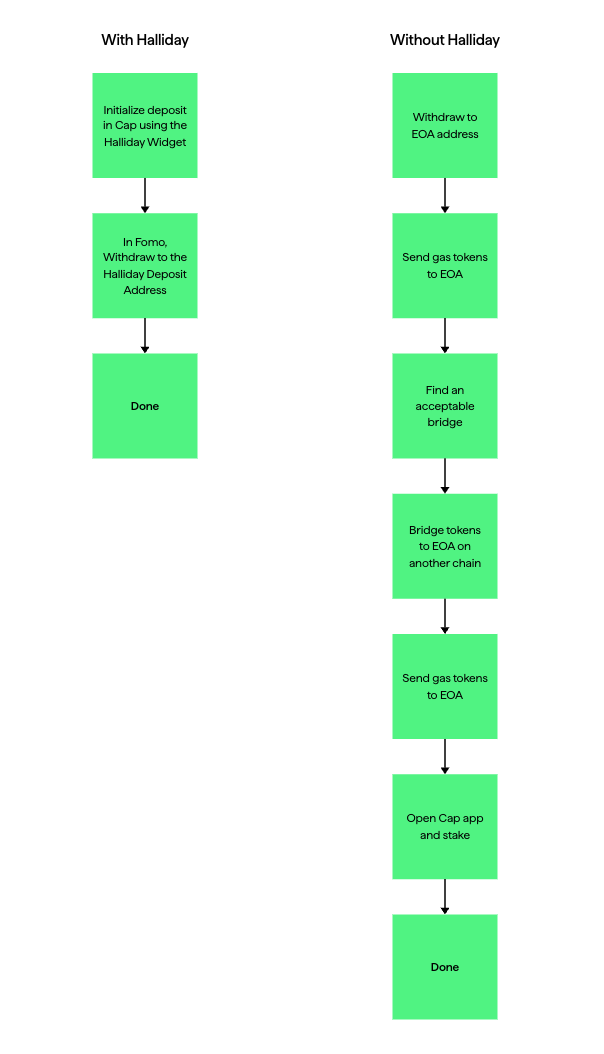
One Less Technical Implementation for DeFi Founders to Build Out
Halliday automates bridging and routing regardless of whether a user withdraws USDC from Fomo on Ethereum or Solana. Halliday quotes available routes, including NEAR Intents and Circle’s CCTP in both fast and slow modes, among other bridges, and selects the option with the lowest cost and latency at the time of transfer. The user sends once, and Halliday delivers Cap stcUSD to their wallet without manual bridging or route selection.
For the Cap team, this removes a significant engineering burden. Building and maintaining cross-chain routing in-house would mean integrating multiple bridges, monitoring their fees and settlement times, handling failures, and updating the system as new routes emerge. By integrating on Halliday, Cap avoids that ongoing work entirely and can direct its time and resources toward its core protocol, while still offering users a deposit path that works from whichever chain or token they start on.
How Cap Got Connected to Halliday
Halliday scales with the ecosystem. When Cap needed cUSD and stcUSD supported, the team reached out, and Halliday’s engineers added the relevant tokens and chains within days. Most EVM and SVM tokens can be added quickly. That same turnaround applies as Cap expands to new networks, so its onboarding path grows without additional work on Cap’s side. For developers, integrating Halliday takes just a few lines of code, turning a major infrastructure project into a feature that ships in days, not months.