
Fund prediction market accounts in seconds.
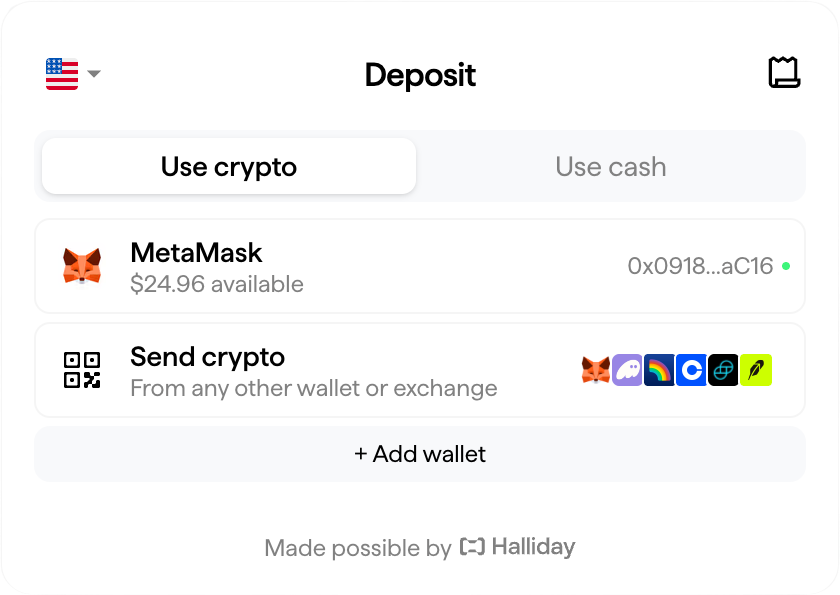
Users fund their account instantly from any CEX, EOA, or with a card or bank balance. The right asset lands on the right chain, ready to trade in seconds.




Supported today
The deposit assets and chains for each of these platforms are live. Integrate the Halliday SDK and your users can fund accounts on them with no further server-side work from Halliday.
- Polymarket
- Kalshi
- Predict.fun
- Hyperliquid
- XO Markets
- Delphi
- ESX Trade
- Closer
Every way a trader can fund an account, in one flow.
Halliday quotes the available paths for each user and ranks them by highest output and lowest latency.
Users pay straight from a Coinbase, Binance, or other centralized exchange balance. Halliday handles the quoting, bridging, and swap into the settlement asset.
Any token held in a wallet, even on another chain, can be bridged and swapped automatically. One confirmation, one interaction.
Debit and credit cards, bank transfers, Apple Pay, and Google Pay through onramp providers, shown to each user based on their location.
Transfer balances between prediction market platforms in seconds with direct onchain routing.
How a deposit works
- 01User clicks deposit in your app
The Halliday widget opens inside your page or webview. No navigation outside your app.
- 02Halliday quotes and routes
Exchange withdrawals, bridges including Circle CCTP, DEXs, and onramps are compared in real time. The user sees the best paths and confirms once.
- 03Funds land where you choose
Set the destination per payment: the user's in-app account or deposit contract so the balance is tradeable immediately, or the user's own wallet on the settlement chain.
Ship deposits before your next big market.
The SDK widget drops a complete deposit and withdrawal UI into your web app or mobile webview on iOS and Android. The headless API is for teams that want funding inside their own market and portfolio screens.
- 01Create an account and get an API key
Sign up at dashboard.halliday.xyz. Get a free API key instantly.
- 02Choose where deposits land
Pass a destination address per payment: the user's in-app account or deposit contract, or the user's own wallet on the settlement chain.
- 03Drop in the widget or call the API
The JavaScript SDK mounts the widget in a container element with a few lines of code. Or use the REST API to quote, create, and track payments behind your own UI.
- 04Subscribe to webhooks
Receive an event on your server when orders complete so balances update the moment funds are delivered.
- 05Go live
One agreement covers every rail, provider, and market. New onramps and chains added to Halliday's routing network become available to your users automatically.
Deposits for prediction markets, answered.
More details in the Halliday documentation.
Which prediction market platforms does Halliday support today?
Halliday supports the deposit assets and chains used by Polymarket, Kalshi, Predict.fun, Hyperliquid, XO Markets, Delphi, ESX Trade, and Closer today. A developer can integrate the Halliday front-end SDK and their users can deposit the correct asset into their prediction market account without any additional server-side work from Halliday.
Can users deposit to a prediction market from Coinbase or Binance?
Yes. Users pay directly from any centralized exchange balance. Halliday handles the quoting, any bridging or swaps, and delivery of the settlement asset on the correct chain, so the user completes one checkout and the balance arrives ready to trade in seconds.
Can users fund a prediction market account with crypto held on another chain?
Yes. A user with USDC, ETH, or other tokens in a wallet on any supported chain confirms once, and Halliday's routing network bridges and swaps into the settlement asset automatically. Routes are compared across bridges including Circle CCTP and across DEXs, and ranked by highest output and lowest latency.
Does Halliday support withdrawals from a prediction market?
Yes. Users can withdraw all or part of a balance to their own wallet, to a centralized exchange deposit address, or offramp to fiat. For example, a user can withdraw pUSD from a Polymarket account on Polygon and receive USDT on Base moments later, because swapping and bridging are built into the withdrawal widget. Withdrawals can be sourced from a smart contract wallet, embedded wallet, smart account, or EOA.
Can users cash out a prediction market balance to fiat?
Yes. After a market resolves, or any time before, users can offramp a balance to a bank account through supported offramp providers without leaving your app. Payout methods and availability depend on the user's location and the provider.
Can users deposit with a debit card or bank transfer?
Yes. Halliday connects several global onramp providers, so users can pay with debit and credit cards, bank transfers, Apple Pay, and Google Pay. Providers are shown based on each user's location, and the purchased asset is delivered on the settlement chain.
Where do deposited funds land?
You choose per payment. The destination can be the user's in-app account or deposit contract, so the balance is tradeable the moment it arrives, or the user's own wallet on the settlement chain.
Is Halliday custodial?
No. Each deposit starts at a deposit address controlled only by the owner address you specify in the API call. Halliday never holds user funds, and a stalled payment can be recovered or retried by the owner, so your platform adds funding without touching customer money.
Does the Halliday widget work on mobile?
Yes. The SDK widget runs in desktop web, on iOS and Android, and with React Native. Teams building a native UI can use the Halliday API, which is platform-agnostic and works the same on desktop and mobile.
How fast are prediction market deposits with Halliday?
Deposits from exchange accounts and from wallets on other chains typically complete in seconds after the user confirms. Fiat onramp times depend on the provider and payment method the user selects.
How long does it take to integrate Halliday into a prediction market?
Most teams ship in days. The JavaScript SDK adds the embedded deposit widget with a few lines of code and webhooks report every order event. The REST API is available for custom UIs.
Read the docs